Auction recap / Bonhams
Bonhams Silver and Objects of Vertu Auction Realizes £599,924
A Private Collection of Indian and Burmese Silver anchored the sale, which achieved a 72.5% sell-through rate.
Auction highlights

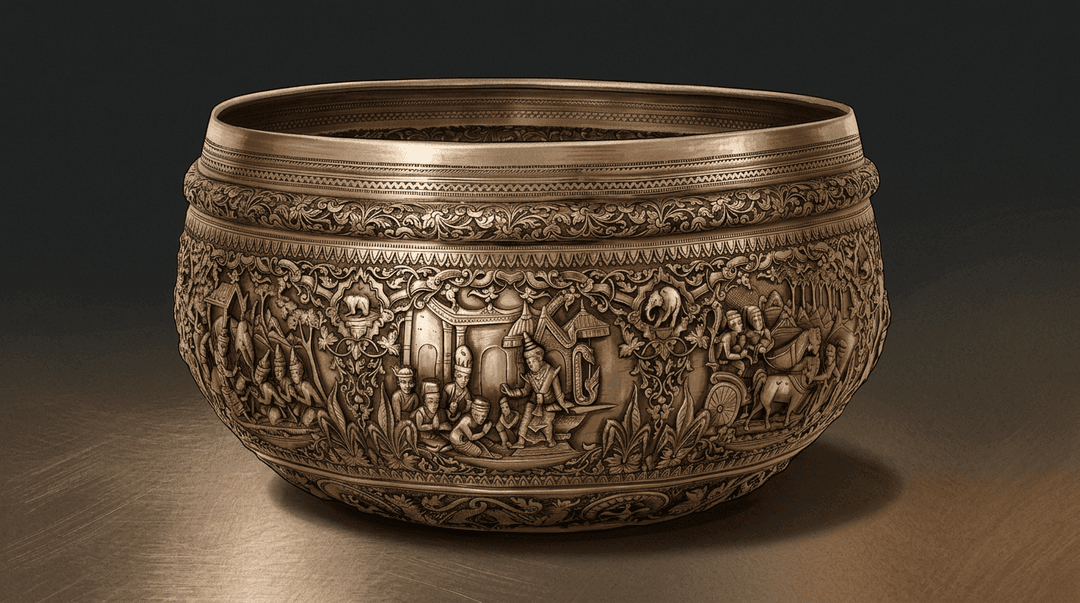
A fine large 19th century Burmese silver offering bowl Burma (Myanmar), circa 1870
Estimate£20–30KSold£26,000Latest bid£20,000 Estimate£18–25KSold—Latest bid—
 Estimate£4–6KSold£18,200Latest bid£14,000
 Estimate£12–18KSold—Latest bid—
 Estimate£10–15KSold£15,600Latest bid£12,000
 Estimate£10–15KSold—Latest bid—

An unusual 19th century Indian silver bowl and stand unmarked
Estimate£4–6KSold£14,300Latest bid£11,000 Estimate£3–5KSold£14,300Latest bid£11,000
 Estimate£6–8KSold£12,350Latest bid£9,500

A 17th century German silver and parcel-gilt tankard David Schwestermuller I, Augsburg, 1665-70
Estimate£8–12KSold—Latest bid— Estimate£4.5–5.5KSold£11,700Latest bid—

A yellow metal and gem-set cigarette case unmarked, engraved Mappin and Webb
Estimate£8–10KSold£11,050Latest bid£8,500


Estimate track marks the pre-sale range; the tick marks the sold price. Lot photography: Courtesy Bonhams.
Contextual data provided by Pricing Culture Analytics; this is not an exhaustive list. Pricing Culture Analytics organizes publicly available auction data to analyze and produce insights.
The Bonhams auction of Silver and Objects of Vertu including A Private Collection of Indian and Burmese Silver in a sale that closed on 21 October 2026 realized a total of £599,924[1]. The sale saw 232 of 320 lots sold, representing a 72.5% sell-through[1] rate. Bonhams served as the official results source for the auction.
The offering was distinguished by a dedicated private collection of Indian and Burmese colonial silver, featuring intricate repoussé and chased decorative work. Among these, a fine 19th-century Burmese offering bowl showcased detailed narrative panels depicting folklore and ritualistic scenes, including a family in a horse-drawn carriage and a couple beneath a tree. Another notable colonial piece, an unmarked 19th-century Indian silver water jug from Madras, featured a double-skinned body decorated in the 'Swami' style. This design includes representations of Durga riding a lion and another deity, likely Vishnu, riding a horse, with a spout formed as a makara or Garuda.
European silver also featured prominently in the sale, led by a monumental German silver and parcel-gilt tankard by August Hosse, dating to circa 1696. The tankard features a pierced sleeve depicting the story of Esther, a figural handle shaped as an angel, and a cover bearing an import mark for Latvia. This piece was previously sold at Sotheby's Geneva in May 1990.
Auction highlights
Sale file- A fine large 19th century Burmese silver offering bowl Burma (Myanmar), circa 1870 | estimate £20,000[2] to £30,000[2] | sold for £26,000[2]
- A rare and exceptional 19th century Indian silver water jug Madras, circa 1875, unmarked, possibly attributed to Peter Orr and Sons, Madras, after a design illustrated in a sales catalogue of P. Orr and Sons | estimate £18,000[3] to £25,000[3]
- A good 19th century Indian silver teapot Mawji Raghavji, Cutch (Kutch), Bhuj, circa 1880, the base is stamped 'MR' over 'BHUJ' | estimate £4,000[8][5] to £6,000[8][5] | sold for £18,200[5]
- A monumental German silver and parcel-gilt tankard August Hosse, Halle / Saale, circa 1696, cover with import mark for Latvia | estimate £12,000[4] to £18,000[4]
- A pair of cast Continental silver three-branch candelabra Christofle, base incuse stamped STERLING, 925, incuse numbered 249 and 252 | estimate £10,000[7][6] to £15,000[7][6] | sold for £15,600[6]
- An extensive silver King's pattern flatware service predominately George Adams, London 1841 - 1842 and 1868, | estimate £10,000 to £15,000
- An unusual 19th century Indian silver bowl and stand unmarked | estimate £4,000 to £6,000 | sold for £14,300[9][8]
- An Indian silver 'hunting scene pattern' pedestal bowl Lucknow, late 19th century, circa 1890, rim of foot signed | estimate £3,000[9] to £5,000[9] | sold for £14,300
The Indian and Burmese silver lots illustrated the diverse regional styles of the subcontinent, such as the Cutch style represented by a teapot by Mawji Raghavji. This baluster-form piece is chased with scrolling foliage, birds including an ibis and a peacock, and animal fight scenes, topped with a scorpion finial. The strong presence of signed and attributed colonial works alongside classic European tableware and monumental hollowware defined the character of this specialized sale.
Sources
- 01
- 02
- 03
- 04
- 05
- 06
- 07
- 08
- 09