Brand Intelligence
Cartier Solidifies Market Position Through Sculptural Form Watches and Unique Commissions
The French house commands attention by emphasizing expressive geometry and rare provenance over standard mechanical complications, driving record-breaking results in the secondary market.
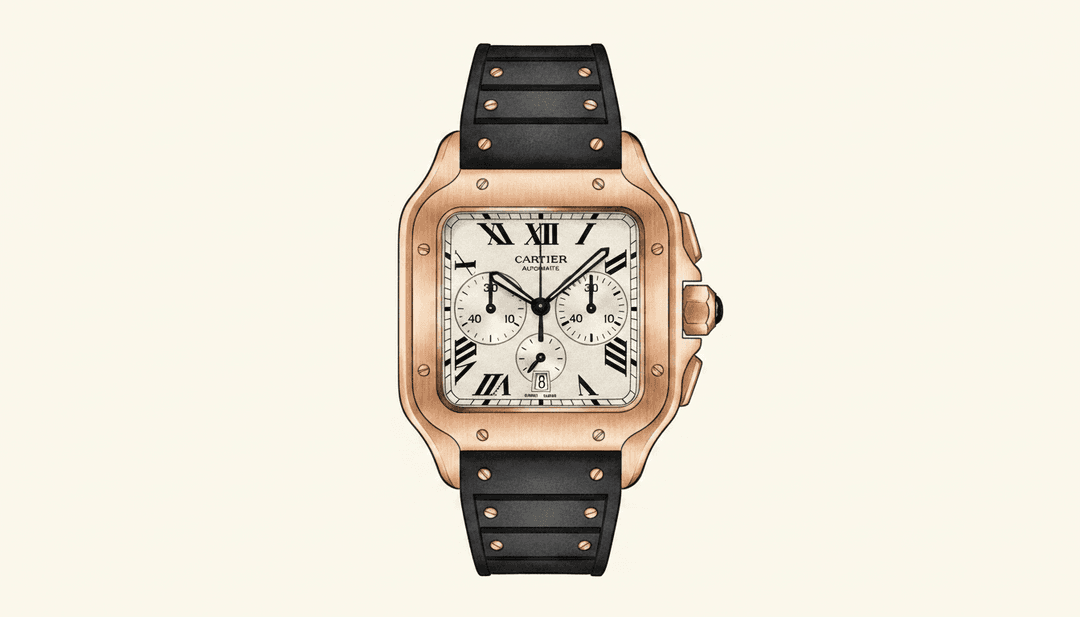
Cartier is solidifying its secondary-market position through highly distinctive sculptural form watches and unique historical commissions that bridge high jewelry and horology. The French house continues to command attention by emphasizing expressive geometry and rare provenance over standard mechanical complications, a strategy that resonates with collectors seeking sculptural design. This focus on aesthetic identity allows the brand to maintain a distinct profile in the secondary market, where collectors increasingly prioritize visual rarity and historical significance over purely technical watchmaking metrics. This trend is particularly evident in how the brand's vintage and unique creations are cataloged and valued, as the market increasingly treats these timepieces as wearable sculptures rather than mere instruments of timekeeping.
This market focus is demonstrated by the recent public sale of a unique white-gold Cartier Cheich, which achieved a record-breaking result at a Sotheby's Hong Kong auction, according to Watches by SJX. Originally commissioned by Italian collector Giorgio Seragnoli, the white-gold timepiece became the most valuable Cartier watch ever sold publicly, as well as the most valuable quartz wristwatch, highlighting the significant premium collectors place on Cartier's most unusual, sculptural form watches, which shifts the valuation basis for rare quartz timepieces. The result demonstrates that the market's appetite for unusual geometry, such as the Cheich's stylized bust design modeled on a Tuareg tribesman's headscarf, can command prices that rival or exceed those of highly complicated mechanical watches from traditional Swiss manufactures.
The intersection of jewelry craft and horology is central to how Cartier manages its brand equity. At the Kyoto National Museum, the house recently unveiled the second chapter of its "Le Choeur des Pierres" high jewelry collection, which WWD reported is shaping up to be the jeweler's largest lineup to date. By showcasing pieces like the Stellara necklace alongside unconventional gem-setting techniques—such as setting brown diamonds with their pavilions facing upward in the Patellia earrings—Cartier reinforces its identity as a master of form and color. This design-led philosophy directly informs the collectible watch catalog, where sculptural layouts and unusual geometry take precedence over traditional watchmaking benchmarks, forcing cataloging teams to adjust their risk controls when evaluating gem-set horology. The emphasis on color exploration and the character of individual stones in these high jewelry pieces mirrors the brand's horological approach, where the case shape and dial composition are treated as a unified artistic canvas.
This cultural footprint is further amplified by structured public exhibitions that keep the brand's contemporary achievements in the spotlight. In London, Watches of Switzerland is preparing to host the first public exhibition of the Grand Prix d’Horlogerie de Genève winners from 2026[1], according to Hodinkee. These curated physical showcases provide a transparent venue for collectors to examine award-winning designs up close, reinforcing the connection between the brand's historical catalog and its modern retail strategy, altering the evidence threshold that advisors use to verify contemporary market demand. By aligning its modern award-winning designs with public exhibition spaces, the brand ensures that its contemporary watchmaking achievements are viewed with the same cultural gravity as its historical museum pieces.
The trajectory of unique commissions also highlights the role of provenance in sustaining secondary-market premiums. The white-gold Cheich, for instance, was originally part of a highly specialized collection of white-metal Cartier timepieces before eventually passing through the hands of specialized dealers, as reported by Watches by SJX. The eventual dispersion of such focused collections demonstrates that while private holdings may remain off the market for decades, their eventual reentry provides critical price discovery that redefines the ceiling for the brand's most elusive designs, thereby changing the denominator of known, transacted assets in this category. This dispersion also highlights the transition of these objects from private, highly curated portfolios into the broader public market, where their historical context is re-evaluated by a new generation of collectors.
Ultimately, the performance of these rare objects suggests that the market for Cartier is driven by a different set of incentives than those governing mass-produced luxury watches. Because these pieces exist at the intersection of fine art, jewelry, and design history, their valuation requires a multi-disciplinary approach that accounts for aesthetic rarity and historical context. For professionals managing these collections, the primary challenge lies in identifying which contemporary releases possess the design purity necessary to replicate this long-term retention of value, a decision moment that requires rigorous historical benchmarking. The ongoing demand for these distinctive form watches suggests that design, provenance, and artistic execution will remain the primary pillars of the brand's secondary-market strength.
Related Coverage
Pricing CultureWatches - Nov 2, 2026
A. Lange & Söhne Reintroduces Platinum Bracelets on the Datograph Perpetual
The German watchmaker has revived a rare metal configuration originally introduced in 2006 to celebrate the twentieth anniversary of its landmark perpetual calendar chronograph.
Recent coverage involving the same entity.
Watches - Nov 8, 2026
Highly Regulated Venues Redefine How Rare Rolex Watches Enter Secondary Market
From government-mandated asset liquidations to brand-certified retail expansions, structured environments are replacing informal peer-to-peer transactions for high-value timepieces.
Recent coverage involving the same entity.
Watches - Nov 2, 2026
Jaeger-LeCoultre Focuses on Archival Proportions and Compact Dress Watch Designs
The watchmaker is reviving historical miniature movements and expanding its classic dress lines to capture demand for understated, jewelry-adjacent aesthetics.
Recent coverage involving the same entity.
Watches - Nov 1, 2026
Piaget Houses Its Record-Setting Ultra-Thin Minute Repeater in Contemporary Polo Case
The Swiss manufacture combines its historic high-complication expertise with modern sport-chic design codes through an extremely limited annual production.
Recent coverage involving the same entity.
Sources
- 01
hodinkee.com
Bring a Loupe: An Omega Ranchero, A Cartier Santos Ghost, An Audemars Piguet Perpetual Calendar, And A ZRC Grands FondsSep 25, 2026
Source passage
Happenings Watches of Switzerland to Host First Public Exhibit of 2026 GPHG Winners In London Bring a Loupe An André Beyner/Maurice Grimm Prototype, A Yema Yachtingraf Regatte, An Omega Seamaster Recife, And A Tropical Rolex Daytona Introducing The Porsche Design Chronograph 1 Utility – Limited Edition for Hodinkee All that and more in this week's edition of Hodinkee's What's Selling Where column. N ext week is October. October . Even for someone who literally has an ongoing documentation of each week through this column, that is mind-blowing. I hope whatever baseball team you're stoked about is doing well—my Twins fell off so long ago that I haven't even been paying attention—and I also hope autumn's making a decent entrance for you wherever you are. Scorekeeping last week's picks , the Omega Suverän sold for 9,600 DKK, the Universal Genève Cabriolet for 2,400 CHF, the Vacheron Constantin Overseas remains available, and the Zenith chrono for €3,000. Hermès watches hardly go unnoticed, but I love that some of their models still fly a good bit under the radar. The Cape Cod, for instance, is fantastic—interesting and elegant without being too weird. This one, the Grandes Heures , features an hour wheel that allows the hour hand to travel differently based on its dial position, meaning it covers more distance from 9-10 than from 10-11, and while that's not any foundation-shaking c
- 02
watchesbysjx.com
Sotheby’s Sets Record Price for Cartier and QuartzSep 22, 2026
Source passage
The Cartier Cheich is one of the jeweller’s most unusual, and rarest, creations. Originally conceived as a prize for winners of the Dakar Rally during the years when the race was sponsored by Cartier, the Cheich was modelled on the rally’s emblem that is a stylised bust of a Tuareg tribesman wearing a headscarf – cheich is French for “sheikh”. Four originals in yellow gold were made, and amongst the recipients were Thierry Sabine, the founder of the Paris Dakar Cartier Challenge, and Gaston Rahier, a driver who won the rally in 1984 and 1985. Sabine’s death in 1986 put an end to Cartier’s sponsorship of the rally. Rahier’s watch was sold by Sotheby’s in 2022 for a little over €1 million with fees. But some 25 years after the original Cheich watches were made, Cartier made one more, in white gold no less. And that watch just sold for US$3.38 million including fees at Sotheby’s stellar Hong Kong auction, making it the most valuable Cartier watch ever sold publicly – and also the most valuable quartz watch ever sold. The result underlines the continuing demand for distinctive Cartier form watches, a category that includes the iconic Crash. The Cheich in white gold was originally commissioned by Giorgio Seragnoli, an heir to an Italian packaging dynasty who was once owned the world’s largest collection of Cartier timepieces, primarily wristwatches in white metals. A native of Bolog
- 03
wwd.com
Why Cartier Revealed the Second Chapter of Its Choeur des Pierres High Jewelry Collection in KyotoOct 18, 2026
Source passage
Gemstones continued to sing in Cartier ’s “Le Choeur des Pierres” high jewelry collection , with a second chapter unveiled at the Kyoto National Museum. Among the 46 new pieces that made their debut in Japan , one caught the most light: the Stellara necklace, with its 41-carat Ceylon sapphire set in a graphic openwork composition, worn by Jisoo ’ at a dinner that drew Sofia Coppola , Japanese actresses Mio Imada, Nanako Matsushima and Haruka Ayase as well as their compatriots Ryo Yoshizawa and Kento Kaku. It epitomized the exploration of color, form and the character of individual stones at the heart of a collection that is shaping up to be the French jeweler’s biggest lineup to date, with a total of 250 jewels, objects and timepieces by the time its third chapter is revealed next year in Hawaii. An initial 130 pieces were shown in April in Saint-Tropez. Also taking pride of place in the second chapter were Patellia, earrings built around a pair of brown diamonds totaling more than 11 carats that were set with their pavilion facing upward, opposite of what is conventionally done, and Tipaza, which figures three strings of ruby beads finished with geometric alternations of diamonds and rubies that appear simply looped around the neck, two briolette diamonds for a cumulated 7.36 carats finishing off two of the strands. There was also Fibria, which figured a two-strand braid inspi